Recent global protests have brought attention to anti-Black racism and have highlighted the need for systemic racism to be addressed in all aspects of society. From a health policy point of view, policy makers and the health sector should examine health equity and health policy through an anti-racism lens.
In our article “Prioritizing Anti-Racism in Health Policy” we examine race as a pervasive determinant of health, the historical and ongoing health policy and system traumas that have entrenched a deep mistrust in many racialized populations around the world, and present some of the key actions needed to develop anti-racist health policies.
There are three broad categories of racism: individual-level discrimination, cultural racism, and systemic racism.1,2
Anti-racism is the active decision to be conscious about race and racism while taking consistent and equitable action to end racial inequalities.2
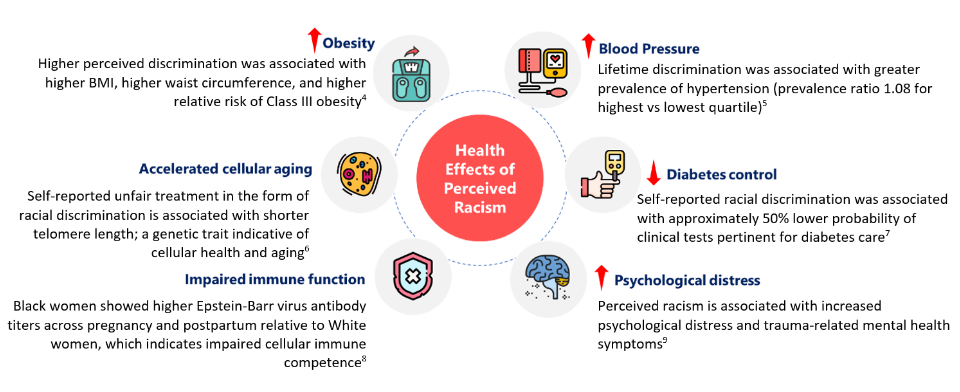
Beyond interaction through classic social determinants of health, the impact of perceived racial discrimination throughout the life course leads to multiple adverse health outcomes.
Policy Wisdom strongly advocates for the power of following a wisdom-informed policy approach to decision making in order to guide a path toward a more equitable and sustainable anti-racist health climate. This approach is collaborative, centers on cultural relevance and need, and seeks the integrability of policies into the societies they intend to service. It is underpinned by values of transparency, engagement, and accountability. All these priorities and values are the framework of the actions outlined below and are fundamental to the development of anti-racist health policy.
Key actions in the development of anti-racist health policy

Build Capacity (Health Policy/Organizational)
- Explicitly acknowledge the roles of racism in health care and how various factors may lead to worse outcomes for particular racialized groups 10
- Standardize and mandate training on internal bias, health equity, anti-racism, anti-oppression, and decolonization11
- Create a precise plan for engagement with stakeholders of racialized populations that highlights key trust-building factors: ability to engage meaningfully, genuine benevolence, and integrity (Note: may be revised upon initial consultation to ensure proper context for all)12

Learn (Engage)
- Prioritize data collection from race-based health sources that span the continuum of care to ensure full-spectrum understanding of prevalent inequities13
- Consult studies including how racial disparities in the transfer of wealth across generations contribute to persistent inequities through time14
- Ensure broad racial diversity in all clinical trials

Consult (Engage)
- Create paid positions and roles for stakeholders of racialized populations to be trust builders and help navigate relationships between communities and the health system15
- Develop a strategy led by communities of racialized populations to identify representatives for community engagement opportunities in health care, and develop engagement practices and methods that reflect the diversity within specified racialized communities
- Improve communication with racialized communities in a health-literate fashion on the purpose and use of the data collected from them, including providing results in a health-literate way and maintaining complete transparency16
- Ensure racialized community voices are included in policy-shaping strategies and in the suggested content and text of policies

Address Gaps (Health Policy/System)
- Provide the platform for stakeholder partners of racialized communities to design, inform and lead the process of addressing gaps; and continuously communicate and utilize their feedback throughout the implementation process
- Bring stakeholders of racialized groups to the ‘head table’ 17

Monitor and Track Outcomes (Health Policy/System)18
- Invest in both short and long-term studies in order to observe the quantifiable health outcome changes that take significant time periods to present
- Support and fund research on the multiple effects of structural racism across racialized communities in measures of health outcomes and health care experience
- Support and fund research into effective strategies to reduce, mitigate, and prevent the effects of racial bias in health
- Ensure research teams are composed of non-traditional participants beyond academics such as community members, local business leaders, think tanks and others

Commit and Advocate
- Cultivate and maintain ongoing relationships with stakeholders of racialized communities
- Continuously acknowledge sources of racial inequities as they arise and commit to action of mitigating the causes
You may view the list of references in the complete version of our article.

In our article “Prioritizing Anti-Racism in Health Policy” we examine race as a pervasive determinant of health, the historical and ongoing health policy and system traumas that have entrenched a deep mistrust in many racialized populations around the world, and present some of the key actions needed to develop anti-racist health policies.
Contact us at info@policywisdom.com to learn more about our wisdom-informed policy approach in the pursuit of an anti-racist health policy climate.